Diploma of Building and Construction (Building)(CPC50220 | CRICOS 120755C)
The purpose of this course is to prepare graduates to apply knowledge, practical skills and experience in the role of building professionals who apply knowledge of structural principles, risk and financial management, estimating, preparing and administering building and constructioThe purpose of this course is to prepare graduates to apply knowledge, practical skills and experience in the role of building professionals who apply knowledge of structural principles, risk and financial management, estimating, preparing and administering building and construction contracts, selecting contractors, overseeing the work and its quality and managing construction work in building projects including residential and commercial with the following limitations:
- Residential construction limited to National Construction Code Class 1 and 10 buildings to a maximum of 3 storeys.
Commercial construction limited to National Construction Code Class 2 to 9 buildings, Type C and B construction.
Face to Face (20 hours per week) with expected independent study of approximately 20 hours per week.
Sample Timetable:
Monday and Tuesday:
8.30 am to 5.30 pm
Wednesday:
8.30 am to 12.45 pm
Southport Campus
Campus 101A 9 Bay Street, Southport, QLD, 4125 Simulated facility 3/10 Hilldon Ct, Nerang QLD 4211
Total Weeks: 52 / Holiday Weeks: 2 / Academic Weeks: 50
This qualification will be delivered over 52 weeks, including 50 weeks of training and assessment and up to 2 weeks of holidays. Note that supplementary classes will be scheduled, and attendance required, should additional classes be required to allow for classes missed as a result of public holidays, or other interruptions, and/or for students who require further training and/or reassessment or additional support.
Potential employment options for graduates of this course are:
- General Foreperson
- Building Inspector
- Builder
Graduates of this course may wish to continue their education into the following programs:
- CPC60220 Advanced Diploma of Building and Construction (Management)
- CPC60121 Advanced Diploma of Building Surveying
| Completion of total number of 27 units are required for the award of this qualification. Core units: 24 units Elective units: 3 units, of which: a maximum of one unit may be from any training package or accredited course as long as it ensures the integrity of the qualification’s Australian Qualification Framework (AQF) alignment and contributes to a valid, industry supported vocational outcome. | |||
| Unit Code | Unit Name | Core/Elective | Pre-requisite |
| CPCCBC4009 | Apply legal requirements to building and construction projects | Core | N/A |
| CPCCBC4001 | Apply building codes and standards to the construction process for Class 1 and 10 buildings | Core | N/A |
| CPCCBC4053 | Apply building codes and standards to the construction process for Class 2 to 9, Type C buildings | Core | N/A |
| CPCCBC5001 | Apply building codes and standards to the construction process for Type B construction | Core | N/A |
| BSBOPS504 | Manage business risk | Core | N/A |
| CPCCBC4003 | Select, prepare and administer a construction contract | Core | N/A |
| CPCCBC4004 | Identify and produce estimated costs for building and construction projects | Core | N/A |
| CPCCBC4005 | Produce labour and material schedules for ordering | Core | N/A |
| CPCCBC4008 | Supervise site communication and administration processes for building and construction projects | Core | N/A |
| CPCCBC4010* | Apply structural principles to residential and commercial constructions | Core | CPCCBC4053 CPCCBC4001 |
| CPCCBC4012 | Read and interpret plans and specifications | Core | N/A |
| CPCCBC4013 | Prepare and evaluate tender documentation | Core | N/A |
| CPCCBC4014 | Prepare simple building sketches and drawings | Core | N/A |
| CPCCBC4018 | Apply site surveys and set-out procedures to building and construction projects | Core | N/A |
| BSBWHS513 | Lead WHS risk management | Core | N/A |
| BSBPMG532 | Manage project quality | Elective | N/A |
| BSBPMG538 | Manage project stakeholder engagement | Elective | N/A |
| CPCCBC4052 | Lead and manage teams in the building and construction industry | Elective | N/A |
| CPCCBC5007 | Administer the legal obligations of a building and construction contractor | Core | N/A |
| CPCCBC5010 | Manage construction work | Core | N/A |
| CPCCBC5003 | Supervise the planning of onsite building and construction work | Core | N/A |
| CPCCBC5005 | Select and manage building and construction contractors | Core | N/A |
| CPCCBC5011 | Manage environmental management practices and processes in building and construction | Core | N/A |
| CPCCBC5013 | Manage professional technical and legal reports on building and construction projects | Core | N/A |
| CPCCBC5018* | Apply structural principles to the construction of buildings up to 3 storeys | Core | CPCCBC5001 CPCCBC4053 |
| CPCCBC5019 | Manage building and construction business finances | Core | N/A |
| CPCCBC5002 | Monitor costing systems on complex building and construction projects | Core | N/A |
Completion of the general construction induction training program specified by the model Code of Practice for Construction Work is required for any person who is to carry out construction work. Achievement of unit CPCWHS1001 Prepare to work safely in the construction industry meets this requirement.
Builder licensing varies across States and Territories and requirements additional to the attainment of this qualification may be required.
Refer to the Queensland Building and Construction Commisson website for further details for licensing in QLD.
Building Commission NSW | NSW Government – Refer to the NSW Building Commission website for further details on licensing in NSW.
All overseas student applicants to HTA are assessed to ensure they meet the appropriate entry requirements. This is undertaken prior to issuing Confirmation of Enrolment for Student Visa purposes.
Although the training package does not stipulate any entry requirements for this training product, HTA has the following entry requirements in place for overseas students
- Be at least 18 years of age.
- Participate in a pre-enrolment review to determine suitability of the course and additional support needs – Refer to pre-enrolment review section on the following page
- Undertake HTA’s ACSF LLN and Digital Literacy assessment – Refer to LLN&D section on the following page
Prospective learners must have taken any of the following test types and achieved the minimum score in the last three (3) years.
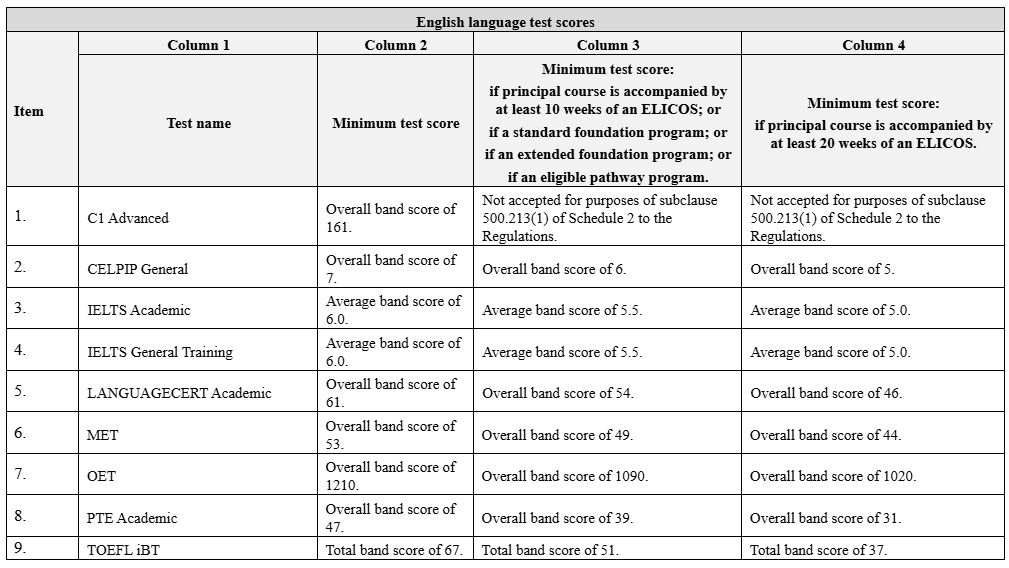
*ELICOS – English Language Intensive Courses for Overseas Students
You are not required to provide evidence of English language requirement if one of the following applies to you:
- You are a citizen and hold a passport from UK*, USA, Canada, NZ or Republic of Ireland
- You are an applicant who is a Foreign Affairs or, Defence sponsored student or a Secondary Exchange student (AASES)
- You are enrolled in a principal course of study that is a registered school course, a standalone English Language Intensive Course for Overseas Students (ELICOS), a course registered to be delivered in a language other than English, or a registered post-graduate research course
- You have completed at least 5 years’ study in English in one or more of the following countries: Australia, UK, USA, Canada, New Zealand, South Africa, or the Republic of Ireland
- In the 2 years before applying for enrolment, you completed, in Australia and in the English language, either the Senior Secondary Certificate of Education or a substantial component of a course leading to a qualification from the Australian Qualifications Framework at the Certificate IV or higher level, while you held a student visa.
Note: You may be required to provide evidence of an English test score with your visa application if you hold a British National Overseas (BNO) passport.
The physical requirements of a plasterer or renderer can be very demanding and it is expected that the prospective learners will have reasonable level of fitness to perform the following tasks:
- Constant hand function (fine and gross) and lifting waist to overhead and carrying up to 20kg
- Frequent standing, forward reaching, overhead reaching and static neck postures;
- Frequent lifting from floor to overhead and carrying from 2kg to 15kg;
- Frequent pushing and pulling;
Bricklayer’s labourers assist with preparation, positioning and distribution of materials and equipment.
They assist with general clean-up associated with laying bricks, stone, concrete blocks and other building blocks to construct and repair walls, foundations and other structures.
Further information about tasks performed and physical requirements can be found here: https://www.worksafe.qld.gov.au/rehabilitation-and-return-to-work/getting-back-to-work/suitable-duties/identifying-suitable-duties/bricklayers-labourer Learners are required to discuss their capabilities in the above areas and any concerns they have during the entry interview.
Students are required to wear and bring their own safety boots.
In addition, all students who are undertaking this qualification must have the following Personal Protective Equipment (PPE) when attending practical training and assessment which are available in the simulated workshop, but students are encourages to purchase and bring their own for health and hygiene purposes.
Personal protective equipment is to include:
- hard hats
- high visibility retro-reflective vests
- safety glasses/goggles
- steel-capped boots
- gloves
- UV protective clothing and sunscreen.
HTA requires all students to undertake an ACSF-level LLND assessment and Pre-enrolment Review upon enrolment to determine the suitability of the course and identify any additional support needs that you may have. HTA provides a range of additional support services, as listed below, which will be offered to you as required and will be identified in your Training and Assessment plan:
- Additional tutorials and mentoring sessions
- Additional handouts
- Additional practice time
- Extensions for assessment submission
- One-on-one time with the trainers
- Specific computer and technology support
- Referral to external support services as required
- Reasonable adjustments
Further details about Student learning, support and well-being are included in our Student Handbook. We have a dedicated Student Support Officer available to support you during your time at HTA. Their contact details will be provided to you during the orientation.
Units are assessed individually via a range of assessment methods: Written Assessment, Verbal Questioning and Practical Demonstrations observed directly by the assessor, including completion of workplace documentation such as Job Safety Analysis, Site plans, SWMS, etc.
You may apply for credit transfer. If you have successfully completed unit/s that have identified equivalence in content and learning outcomes between matched qualifications. If, upon successful application, you are granted Credit Transfer for the unit/s, you are not required to enrol in or undertake the unit/s. This will appear on your Record of Results or Statement of Attainment. No additional charges apply for the Credit Transfer application. Credit Transfers will be discussed with you, and you will have the opportunity to apply for them during your Pre-enrolment Review.
Successful outcomes of your Credit Transfer application may reduce your course duration and will be reflected in your Training and Assessment plan.
HTA offers all students the opportunity to apply for Recognition of Prior Learning (RPL). HTA has a methodical RPL process, which is outlined in detail in the Student Handbook.
‘Recognition of Prior Learning (RPL) means an assessment process that assesses the competency/s of an individual that may have been acquired through formal, non-formal and informal learning to determine the extent to which that individual meets the requirements specified in the training package or VET accredited courses.
- Formal learning refers to learning that takes place through a structured program of instruction and is linked to the attainment of an AQF qualification or statement of attainment (for example, a certificate, diploma or university degree);
- Non-formal learning refers to learning that takes place through a structured program of instruction, but does not lead to the attainment of an AQF qualification or statement of attainment (for example, in-house professional development programs conducted by a business); and
- Informal learning refers to learning that results through experience of work-related, social, family, hobby or leisure activities (for example, the acquisition of interpersonal skills developed through several years as a sales representative).
Students are encouraged to apply for RPL prior to or immediately after formal enrolment, but prior to the facilitated delivery of units, to ensure that you do not miss any class/workshop opportunities offered should you be unsuccessful in the RPL process. Students are given a Training and Assessment plan showing the units you need to complete and methods for undertaking learning and assessment in those units.
Total Fees:
Tuition Fees: $AU 25,0000
Non-Tuition Fees: $AU 1,500
RPL Fees
Application fees: $500
Refer to the Fees and Refunds policy in the student handbook or on our website for further details.
Contact HTA to express your interest using any of the following methods, and one of our Enrolment Officers will take you from there. You can find our student handbook on our website or get in touch, and we can send one to you. If you have any further questions or would like to discuss your circumstances,
Please contact us.
Call us: +61 755564776
Email us: admissions@hta.edu.au
Website: www.hta.edu.au
Career Outcomes
Further Study Pathways
Course Details
Code
CPC50220 | CRICOS 120755C
Duration
52 Weeks
Delivery
Face to Face (20 hrs/week) + 4 hrs independent study
Tuition Fee
$25,000
Non-Tuition Fees
$1,500
Enrol in this course
Start your journey today. Get in touch with our admissions team for intake dates.
Enquire Now